Throughline for Developers
Most document formats are not nearly detailed enough for storytelling purposes. They only contain the text of a story, but the text is just the outcome of the writing process! The decisions behind it live somewhere else: what purpose and position a scene has in an arc, what a character wants and needs, how two characters behave toward one another. They sit in the writer’s head and, maybe, in loose notes.
A .thrl (“thrill”) file contains all that information. It stores every Beat in story order with its summary, cast, Setting and, of course, script. It stores what each Character wants, what they need and the flaw in their way. It stores relationships as feelings that change from Beat to Beat, and each plotline as an Arc. Software that reads a .thrl reads the story as the writer planned it. The file is gzip-compressed UTF-8 JSON, so any programming language reads it with standard tools. Since format version 1.9, every file explains its own data model in a guide block. The format specification is free to use under CC BY 4.0, and any person or company may build software that reads .thrl files.
Give your users the whole story, not just the text. A few lines of code open a .thrl file in Python or JavaScript, with no extra packages. Read your first .thrl file →
What a .thrl file contains
Section titled “What a .thrl file contains”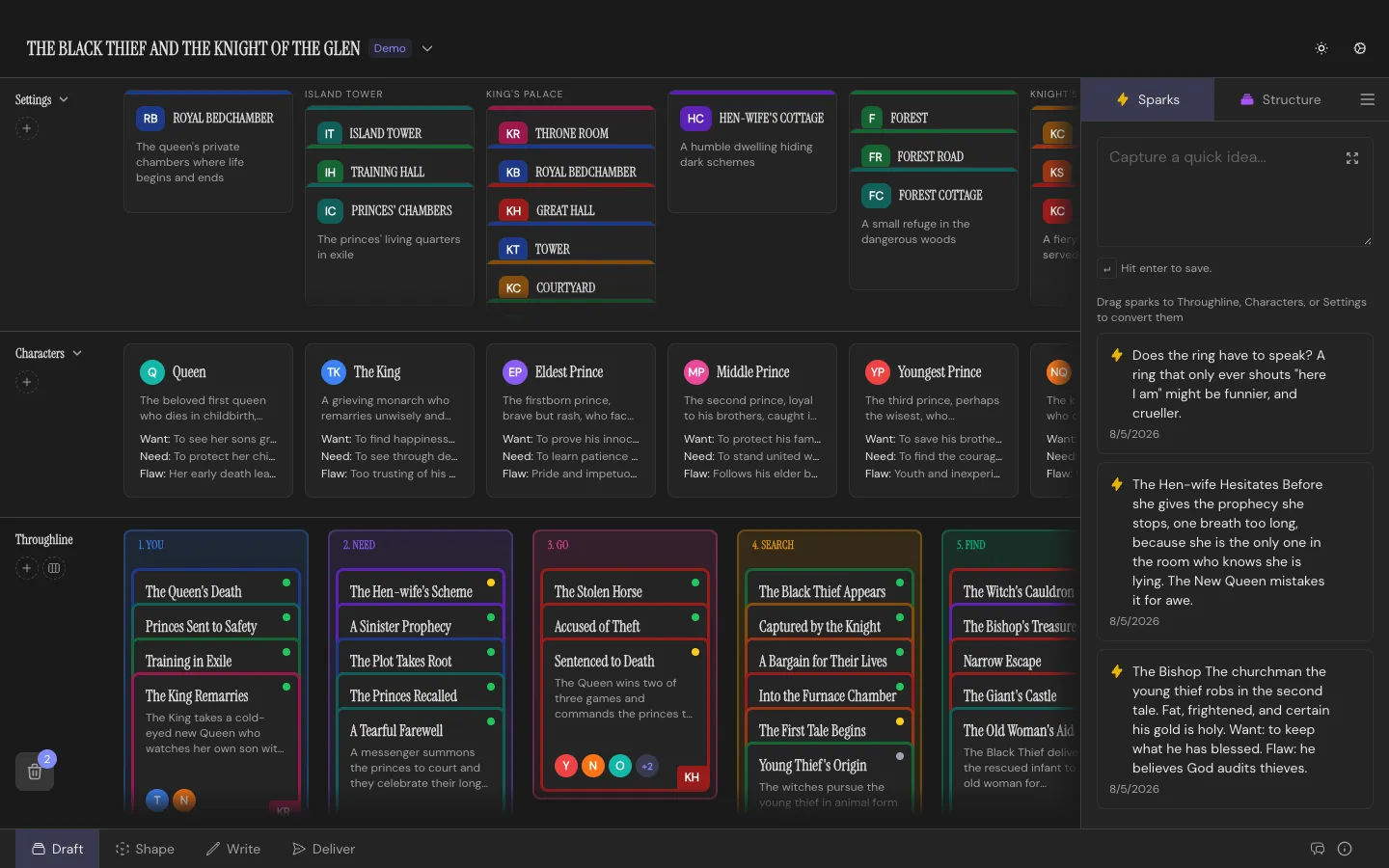
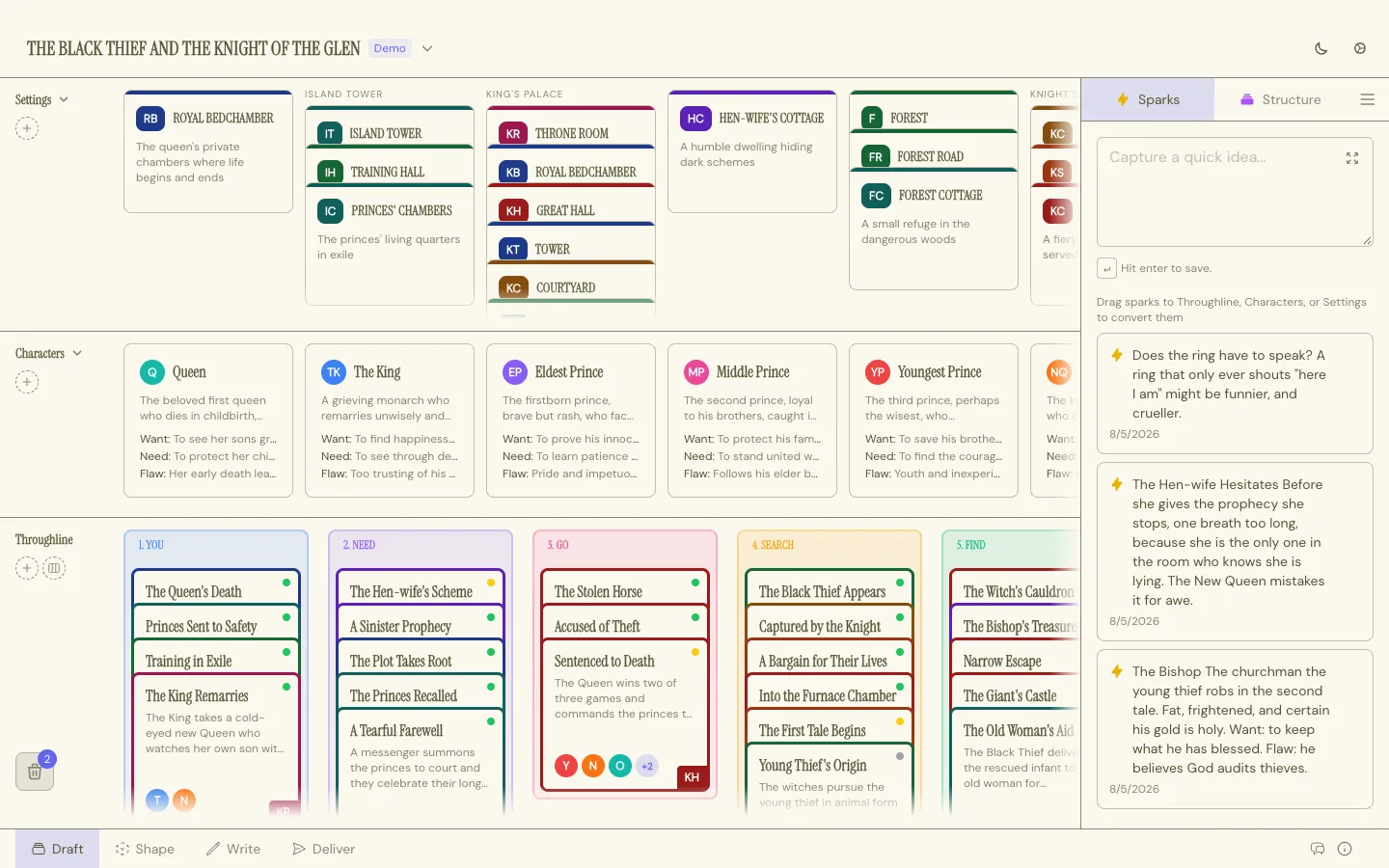
Everything you see here is in the file, down to the last stack and Spark.
| Part | What it contains |
|---|---|
| Beats | Title, summary, status, cast, Setting, INT/EXT, time of day, scene number and script, in story order. |
| Script | Each Beat’s scene text as a structured document: action, cues, dialogue, parentheticals, transitions, dual dialogue and alternate versions. |
| Structure Cards | What each part of the story structure has to do, such as “Inciting Incident”. The Beats stacked on a card fulfill it. |
| Characters | Name, color, summary, want, need, flaw and notes, plus a position on the relationship map. |
| Relationships | How each Character feels about another, such as “distrusts” or “mourns”, and how that changes from Beat to Beat. |
| Arcs | Each plotline between two poles the writer names, with a charge from -1 to +1 at each of its Beats. |
| Settings | Every location with its description, grouped in stacks, for example the rooms of one house. |
| Sparks | Loose ideas waiting in the inbox to become cards. |
| Project details | Title, logline, project language and the title page. |
| Recycling bin | Deleted cards, so the writer can still restore them. They aren’t part of the story. |
How .thrl compares to other formats
Section titled “How .thrl compares to other formats”This compares what each file format can contain, not the apps that use them.
| .thrl | Fountain | Word and PDF | Markdown | |
|---|---|---|---|---|
| Script with element types (action, cue, dialogue) | Yes | Yes | Text only | Text only |
| Scene headings | Yes | Yes | Text only | Text only |
| Scene summaries | Yes | Yes | Text only | Text only |
| Story structure | Yes | Yes | Text only | Text only |
| Character want, need and flaw | Yes | Text only | Text only | Text only |
| Relationships that change from Beat to Beat | Yes | Text only | Text only | Text only |
| Arcs with a charge at each Beat | Yes | Text only | Text only | Text only |
| Explains its own data model inside the file | Yes | No | No | No |
Text only means the format can contain it as text, but software can’t read it as data.
Fountain is great at what it’s for: a script that reads well in any text editor and works with version control. Throughline imports and exports it, and imports Final Draft’s FDX too (see Importing and Exporting). So if you’re exchanging a script, Fountain will do, and if you’re exchanging a story, that’s what .thrl is for.
License
Section titled “License”Creative Commons Attribution 4.0 International
The .thrl specification, the pages in this Throughline for Developers section, is licensed under CC BY 4.0.
You’re free to:
- Build software that reads, converts or displays
.thrlfiles, commercial or not. It’s free of charge, and you don’t have to ask. - Share the specification: copy it and pass it on in any medium or format.
- Adapt the specification: change it and build on it.
Under one condition:
Attribution. Credit the specification with this line:
.thrl format specification by Peak State Entertainment GmbH (https://getthroughline.com/docs/developers/), licensed under CC BY 4.0.- Code examples on these pages: MIT License.
- Not covered: the Throughline name and logo.
- Copyright: Peak State Entertainment GmbH.