Dan Harmon's Story Circle, explained
Eight steps, adapted from Joseph Campbell's Hero's Journey.
The short answer
The Story Circle is an eight-step story structure by Dan Harmon: a character in a comfortable place wants something, goes somewhere unfamiliar to get it, gets it, pays a price for it, and comes home changed.
Harmon created Community and co-created Rick and Morty, and he wrote the circle up years earlier for Channel 101, the short-film night he co-founded in Los Angeles, where pilots had to come in under five minutes. That origin is why it’s so compact. It was built to work on very short stories, and it scales up from there.
The eight steps
Harmon gives each step a one-word label, which is how most people remember it:
- You. A character is in a zone of comfort.
- Need. But they want something.
- Go. They enter an unfamiliar situation.
- Search. They adapt to it.
- Find. They get what they wanted.
- Take. They pay a heavy price for it.
- Return. They go back to their familiar situation.
- Change. Having changed.
Draw the steps around a circle, starting at the top and going clockwise, and a horizontal line through the middle splits it in two. The top half is the familiar world and the bottom half is the unfamiliar one. Steps 3 and 7 are the crossings, out and back, and step 5 sits at the very bottom, which is why getting what you wanted lands right in the middle of the story rather than at the end.
Where it comes from
The circle is a simplified version of the monomyth Joseph Campbell described in The Hero with a Thousand Faces, the same pattern behind the Hero’s Journey that screenwriters usually meet in its twelve-stage form. Harmon kept the shape (departure, ordeal, return) and dropped everything that only fits myths, like mentors with magic swords and supernatural aid.
What’s left is small enough to use on anything: a feature, a 22-minute episode, one character’s subplot inside that episode, or a single scene.
An example: The Wizard of Oz
- You. Dorothy is on the farm in Kansas.
- Need. She wants to be somewhere over the rainbow, and to keep Toto away from Miss Gulch.
- Go. The tornado drops her in Oz.
- Search. She follows the yellow brick road and picks up the Scarecrow, the Tin Man and the Lion on the way.
- Find. She reaches the Wizard in the Emerald City, the one person who can send her home.
- Take. The price: he wants the Wicked Witch’s broomstick first, which gets her captured by the Witch, and the Wizard turns out to be a fraud anyway.
- Return. She clicks her heels together and wakes up in Kansas.
- Change. The girl who wanted to be anywhere else now knows there’s no place like home.
Steps 2 and 8 are the important pair here. What Dorothy wants at the start and how she has changed at the end are about the same thing, home, and that’s what makes the circle close.
Story Circle vs three acts
The circle maps onto three acts without much trouble. Steps 1 and 2 are the first act. Steps 3 to 6 are the second, with step 5 as the midpoint. Steps 7 and 8 are the third act. If you already think in acts, the circle adds two things: it puts getting what you wanted at the midpoint, and it insists that it costs something.
How to use the Story Circle
- Start with Need and Change. Write steps 2 and 8 first. If what the character wants has nothing to do with how they change, the circle won’t close, however good the middle is.
- Fill the opposite steps in pairs. Points across the circle from each other mirror each other: comfort and getting what you wanted (1 and 5), wanting and paying for it (2 and 6), going in and coming back (3 and 7), adapting and having changed (4 and 8). Writing them in pairs keeps the second half answering the first.
- Run a circle per character. In an ensemble story each character can go round their own circle, and the good episodes are the ones where those circles cross.
- Use it on scenes. A single scene can go round the circle too: someone walks in wanting something, gets it, and leaves different.
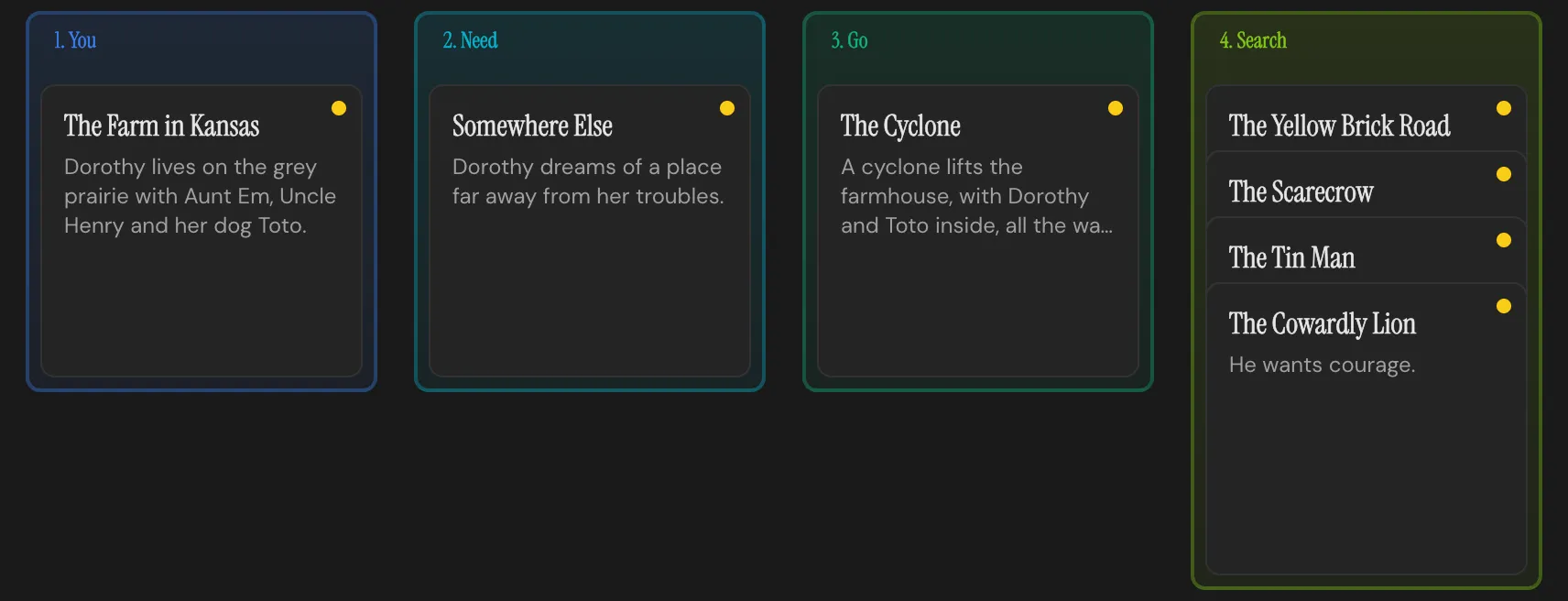
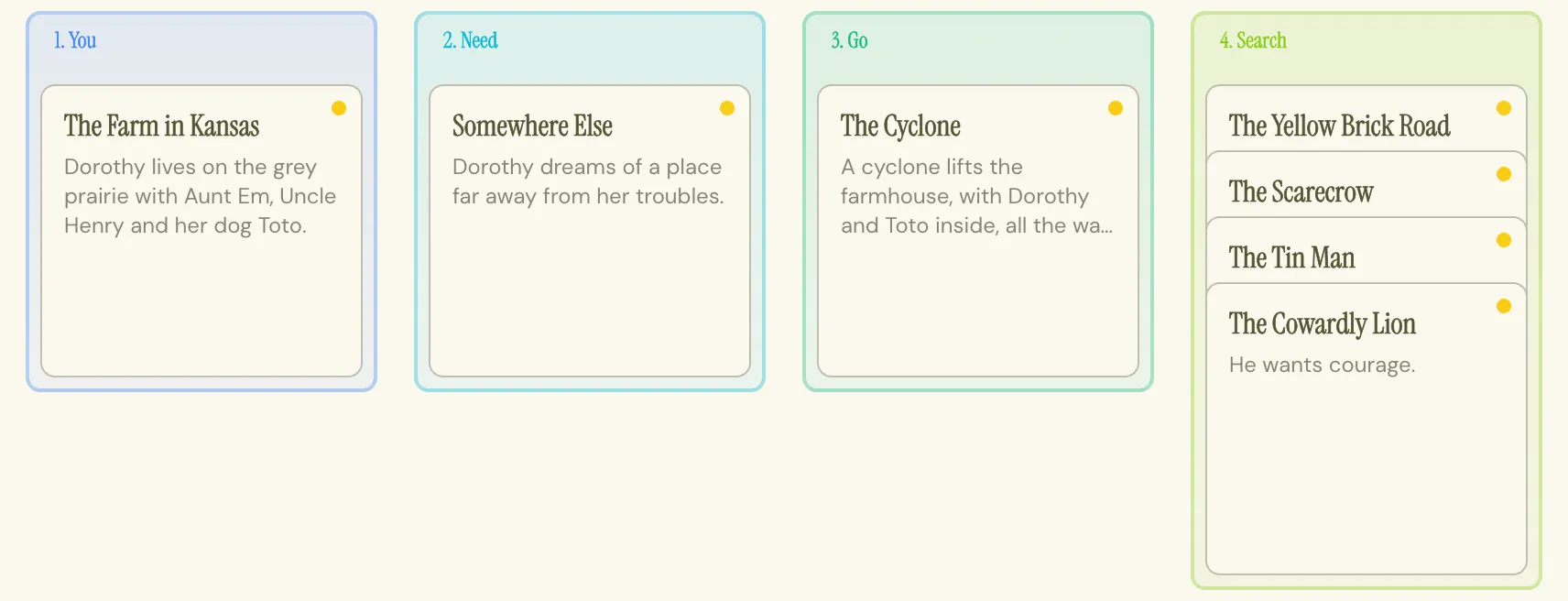
The first four steps of the Story Circle as a board, filled in with The Wonderful Wizard of Oz: one header card per step, and the scenes that fulfil it stacked underneath, so a crowded step and a thin one show at a glance. Laid out in the Draft Workspace of the Throughline App.
Where the Throughline App comes in
The Story Circle comes built in as a Structure Deck. In the Draft Workspace you open the Structure tab, pick the Story Circle and hit Add All, and the eight steps land on your Throughline row as Structure Cards. You stack your own Beats underneath each one as you work out what happens there. Placed cards are yours to change: rename a step, rewrite its guidance, recolor it, and nothing drifts back to the template.
So here’s the pitch. Once the steps are filled in, the Shape Workspace lets you chart how far your character’s fortune really drops at step 6, as an Arc you can compare against classic Story Shapes, and the Write Workspace turns the same Beats into a properly formatted screenplay. Other classic structures come built in too, and you can build and share your own Structure Decks if the circle isn’t your thing. You buy the Throughline App once and it runs offline on your own machine, so there’s no subscription to keep paying while you figure out step 6!
When a story ends without landing, check step 6 first. A character who gets what they wanted without paying anything for it has nothing to change about at step 8, so the fix for a weak ending is often in the middle of the script rather than in the last ten pages.